Journal
How Did They Survive?
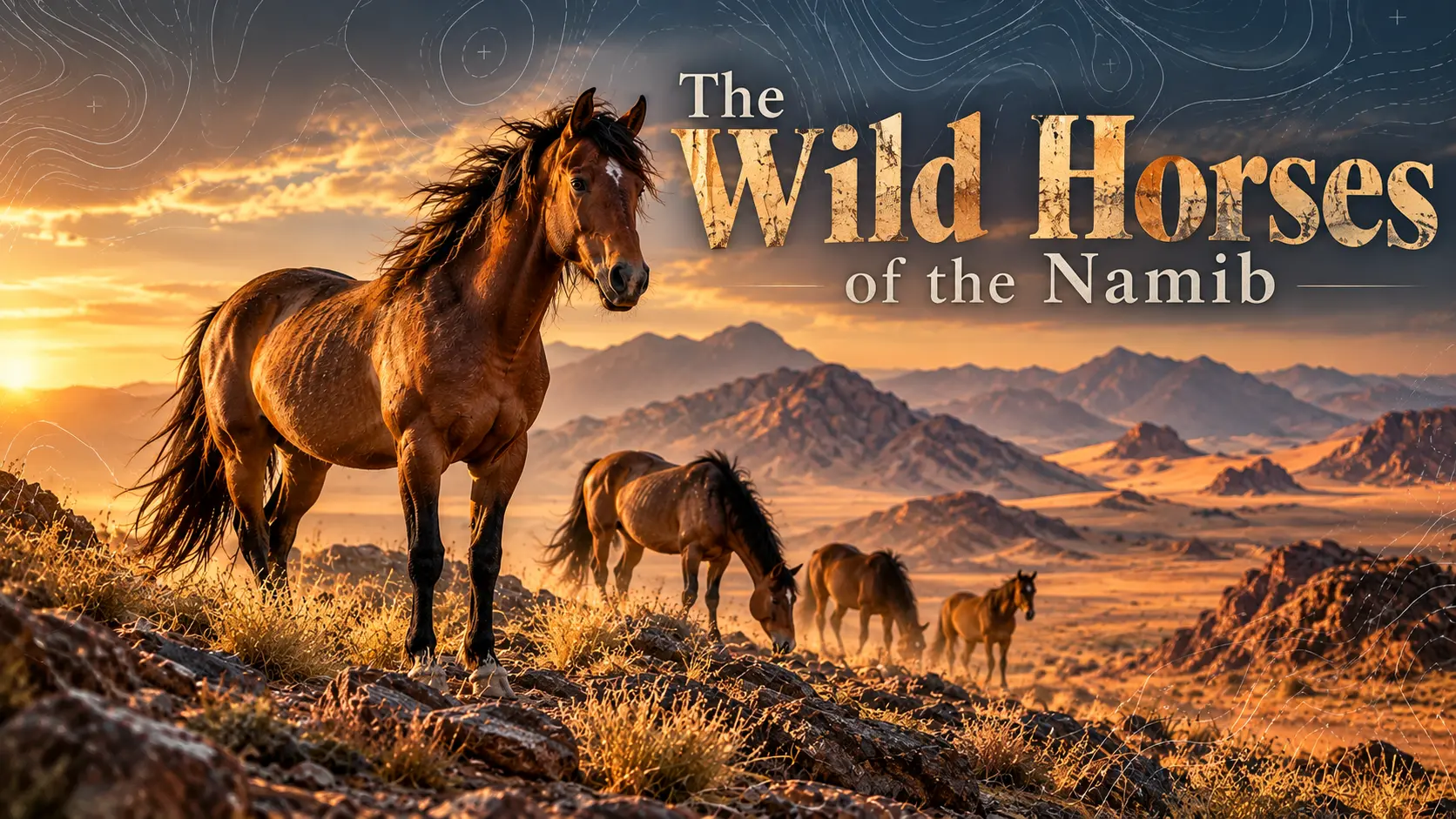
For more than a century, a herd of horses has lived on the edge of one of the world's oldest deserts. They were not born wild. They were never meant to live there. Yet somehow, generation after generation, they survived. There are few places on Earth where the idea of a horse seems more out of place than the Namib Desert. The Namib is a land of extremes. Rainfall is scarce, vegetation can be almost impossible to find, temperatures can swing dramatically between day and night, and vast gravel plains stretch toward enormous sand dunes. Yet on the edge of this unforgiving landscape, near the small railway settlement of Garub in southern Namibia, horses have been surviving for more than a century. They are known as the Wild Horses of the Namib. But there is an important distinction. They are not truly wild in the sense of having evolved in Africa as a native species. They are feral horses, descendants of domesticated animals that escaped or were abandoned more than a hundred years ago. Over generations, however, natural selection, isolation, and the harsh desert environment transformed them. Their story is one of war, abandonment, water, drought, predators,s and extraordinary endurance. And perhaps the most remarkable question is not how they became wild. It is: How did they survive at all?
Born from War: The story of the Namib horses begins during one of the most turbulent periods in Southern African history. During the First World War, what was then German South West Africa became a battlefield between German forces and troops of the Union of South Africa. Horses were enormously important to both sides. Before mechanised transport became dominant, armies depended heavily on horses for transportation, communication, reconnaissance and military operations. Thousands of horses were therefore concentrated in the region around Aus and Garub. Historical accounts indicate that thousands of horses were present around Garub during the war. On 27 March 1915, a German aircraft attacked a South African military camp near Garub. The bombing scattered large numbers of horses. Some were eventually recovered. Others were not. And some of those animals disappeared into the surrounding desert. But the horses' origins appear to have been more complicated than a single wartime event. Research suggests that the ancestors of today's Namib horses came from several sources, including horses bred at nearby stud farms, military horses belonging to both German and South African forces, and other domesticated horses that were abandoned or escaped during the upheaval of the period. One particularly important source appears to have been the Kubub stud farm, where horses were bred for work and racing before the First World War. Eventually, different groups of horses came together around the Garub area. And there they found something absolutely essential. Water.
The Water That Made Survival Possible: If there is one thing that explains the continued existence of the Namib horses, it is not some mysterious ability to live without water. It is the opposite. They found a reliable source of it. A borehole had been established at Garub to provide water for the railway and steam locomotives travelling through the desert. That artificial water source became a lifeline for the horses. The horses would move across the surrounding plains in search of grazing before returning to the waterhole. The landscape around Garub may look almost completely barren at first glance, but after sufficient rainfall, grasses emerge across parts of the plains. The horses learned to move with the availability of this vegetation. Water became the centre of their world. Grazing grounds became their food supply. And the desert itself became their home. Interestingly, research into the horses' physiology found that Namib horses were smaller than domestic Boerperd horses and had a lower overall water turnover. Researchers concluded that their smaller size may contribute to their ability to survive in the desert. But their survival wasn't simply a matter of having tougher bodies. Their behaviour changed too.
Learning to Live in the Desert: A domestic horse normally depends heavily on humans for food, water, shelter, and protection. The horses of the Namib had none of those luxuries. They had to make their own decisions. Where should they graze? When should they travel? When should they drink? Where should they rest? And, perhaps most importantly, how far could they travel before returning to water? Over generations, the horses became increasingly adapted to their environment. Their bodies became smaller. Their behaviour became more efficient. They developed an extraordinary tolerance for dehydration. Research into desert-dwelling horses found that Namib horses could tolerate significant dehydration, including a reduction in body mass of around 12% under experimental conditions. That does not mean they can simply live without water. It means they are remarkably capable of coping with periods when water is unavailable. That distinction is important. The horses did not defeat the desert. They learned how to negotiate with it.
A Horse's Life Without Humans: Perhaps the strangest part of the story is that these horses gradually returned to behaviours that had been suppressed by domestication. They formed social groups. Stallions competed for mares. Foals were raised within herds. Animals that were weak or inexperienced faced greater risks. And natural selection began to influence which animals survived long enough to reproduce. For decades, the horses lived in an area where human access was heavily restricted because of diamond mining. The region formed part of the Sperrgebiet, a restricted diamond-mining area. This accidental protection was enormously important. Humans could not easily enter the area, and the horses were largely left alone. In a strange twist of history, an industry that had nothing to do with wildlife conservation helped create a refuge where the horses could survive with relatively little human interference. For generations, the desert became their sanctuary.
The Desert Has No Sympathy: But surviving for a century does not mean life in the Namib is easy. Far from it. The greatest threat has always been drought. When the rains fail, the grass disappears. When the grass disappears, the horses must travel farther to find food. As their bodies lose condition, they become increasingly vulnerable. Foals and weaker animals are particularly vulnerable to predators such as spotted hyenas. Namibia's management plan for the horses identifies both drought and predation as major pressures on the population. During severe droughts, the horses can become dangerously thin. This creates one of the great conservation debates surrounding them. Should humans intervene? Or should the horses be left entirely to natural processes? It is not an easy question. These animals are descendants of domestic horses, and their survival already depends partly on an artificial water source created by humans. At times, conservation authorities and organisations have also provided emergency food during severe droughts. So where does nature end and human intervention begin? The Namib horses make that question particularly difficult to answer.
Not Quite Wild, Not Quite Domestic: The horses occupy a strange place in the natural world. They are not indigenous to Namibia. There were no native horse populations evolving naturally in Southern Africa before horses were introduced by humans. Yet after more than a century in the desert, calling them simply "domestic horses" doesn't tell the whole story either. They have lived independently for generations. They have survived droughts. They have established social structures. They have adapted physically and behaviourally to their environment. And they have become an iconic part of the landscape around Garub. This is why they are often described as feral horses rather than truly wild horses. Their story is essentially one of domesticated animals becoming wild again.
The Price of Survival: The horses' greatest strength can also become their greatest weakness. They are extraordinarily resilient, but they live in an environment where even small changes can have enormous consequences. A good rainy season can transform the plains. A prolonged drought can turn the same landscape into a graveyard. Population numbers have fluctuated dramatically throughout their history, and periods of severe drought have caused major losses. There is also a broader question about their place in Namibia's conservation landscape. Should they be protected because they are now part of Namibia's natural and cultural heritage? Or should they be regarded as an introduced species whose population should be managed differently? There is no simple answer. Their history is inseparable from human history. Their survival is partly dependent on human infrastructure. And yet their ability to survive independently for more than a century is undeniably remarkable.
More Than Just Horses: Standing at Garub and watching these animals move across the plains, it is easy to see only horses. But look closer, and their story becomes much bigger. They represent the collision of war and wilderness. They are descendants of animals brought to Africa for human purposes. They became scattered by conflict. They found refuge beside a railway waterhole. They disappeared into restricted diamond country. They endured drought. They faced predators. And generation after generation, they adapted to a landscape that should never have been their home in the first place. The horses of the Namib are therefore not simply a wildlife story. They are a living historical record. Every herd carries part of a story that began more than a century ago, when armies, settlers, railways and horses converged on the edge of one of the world's harshest deserts.
So, How Did They Survive? The answer isn't one extraordinary adaptation. It was a combination of factors. Water. The Garub borehole provided a reliable source in an otherwise extremely arid environment. Mobility. The horses could move across large areas searching for grazing. Natural selection. Animals better suited to the environment were more likely to survive and reproduce. Behaviour. The herd developed ways of managing water, food and movement without human care. Isolation. Restricted access to the area protected the horses from much of the hunting and interference that could otherwise have threatened them. Genetics. Their ancestors came from relatively strong riding and breeding stock, rather than simply being random farm animals. And perhaps most importantly: Time. More than a hundred years of surviving one drought, one generation, and one harsh season after another.
The Horses That Refused to Leave: The Namib Desert is often described as one of the oldest and driest deserts on Earth. It is a place where life has learned to survive with almost nothing. And somehow, horses became part of it. They were never supposed to be there. They were brought by people. War scattered them. History abandoned them. The desert tested them. Yet they remained. Today, when a herd of Namib horses moves across the gravel plains near Garub, there is something almost surreal about seeing them there. Their silhouettes against the desert seem to belong to another world. But they are very real. They are survivors of a forgotten chapter of Southern African history. And perhaps that is what makes them so fascinating. They didn't conquer the Namib. They simply refused to give up.
New drops and field notes.
Built in South Africa · ESTD 2025