Journal
African Wild Dogs and Their Role in the Southern African Wilderness
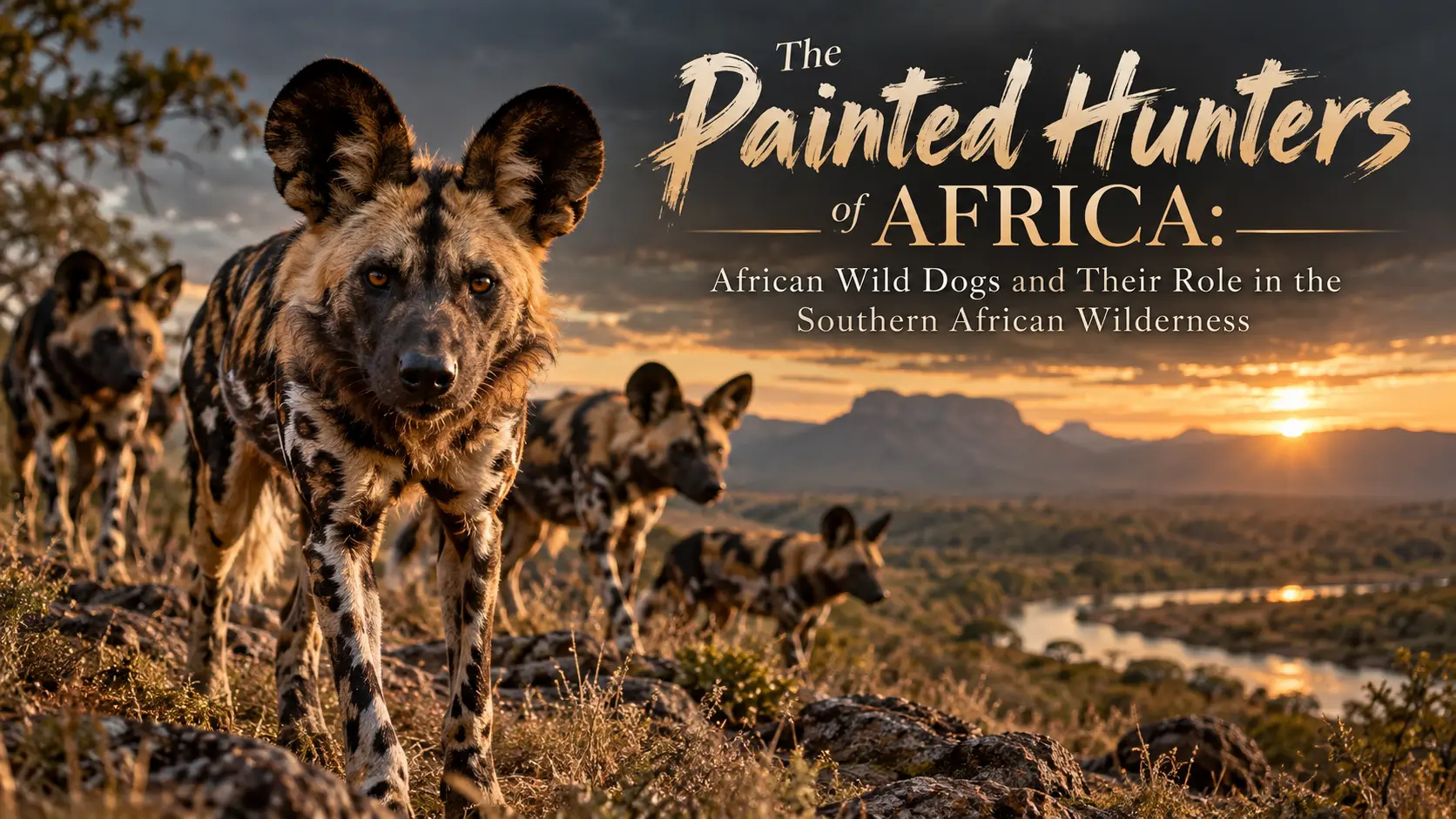
Few animals represent the wildness of southern Africa quite like the African wild dog. With their enormous rounded ears, long legs, and unmistakable coats of black, brown, white, and golden patches, they look almost as though nature painted every individual differently. But beneath their striking appearance lies one of Africa's most fascinating predators. The African wild dog, Lycaon pictus, is not simply another carnivore competing for prey on the savanna. It is an exceptionally social, highly coordinated predator whose survival depends on cooperation. From raising pups to hunting, defending territory, and caring for injured pack members, almost everything a wild dog does is connected to the pack. And in the ecosystems of southern Africa, these remarkable animals play an important role in maintaining the natural balance.
A Predator Unlike Any Other: African wild dogs are sometimes called painted dogs or Cape hunting dogs, but despite their dog-like appearance, they are not simply wild versions of domestic dogs. They belong to their own genus, Lycaon, and are the only living species in it. Their scientific name, Lycaon pictus, roughly translates to "painted wolf", referring to their beautifully mottled coats. No two wild dogs have exactly the same markings, making their patterns almost like fingerprints. They are also unusual among African canids because they have four toes on each foot, rather than the five toes found on the forefeet of many other canids. Their bodies are built for endurance: long legs, a lightweight frame, large lungs, and powerful cardiovascular systems allow them to pursue prey over considerable distances. They are not built to overpower prey like a lion. They are built to outlast it.
The Ultimate Team Hunters: Perhaps the most extraordinary characteristic of African wild dogs is the way they hunt. A lion may rely heavily on strength and ambush. A leopard depends on stealth. A cheetah relies on explosive acceleration. Wild dogs have another weapon: teamwork. A pack may spread out while travelling and then suddenly come together when prey is located. During a chase, individual dogs can change positions, allowing the pursuit to continue while other members conserve energy. Rather than relying entirely on one explosive sprint, wild dogs can maintain a high-speed pursuit for considerable distances. Their primary prey includes medium-sized antelope such as impala, although they can also take animals such as kudu, wildebeest calves, and warthogs. Their hunting strategy allows them to exploit prey that might be difficult for a solitary predator to capture. Their efficiency is remarkable. But there is an important misconception about wild dogs that deserves attention.
They Do Not Simply "Kill Everything": Wild dogs have historically been portrayed as excessively destructive predators because of the intensity of their hunts. That interpretation is misleading. Predator populations and prey populations are connected through complicated ecological relationships. Wild dogs are not simply machines that continuously reduce prey numbers. Their own numbers are influenced by the availability of prey, habitat, competition, and environmental conditions. SANParks notes that predators can play an important ecological role without simply controlling prey populations on their own. Instead, predator and prey populations are part of a much larger system influenced by factors such as rainfall, vegetation, and food availability. This is one of the reasons predators are so important to healthy ecosystems.
The Wild Dog's Role in the Ecosystem: So what exactly does an African wild dog contribute to the wilderness? The answer goes far beyond simply eating antelope.
They Help Regulate Prey Populations: Wild dogs are predators of herbivores, particularly medium-sized antelope. By removing animals from prey populations, they participate in the natural predator-prey cycle. Predators can also disproportionately encounter vulnerable animals, including individuals that are young, injured, or otherwise less capable of escaping. This does not mean wild dogs exclusively target sick animals, nor does it mean predators independently control entire prey populations. Rather, predation is one component of the broader ecological system that determines population dynamics.
They Influence Prey Behaviour: The presence of predators can affect where and when herbivores feed, rest, and move. An impala doesn't need to be killed for a wild dog to influence the ecosystem. Simply having a predator in the landscape can change how prey use their environment. This creates what ecologists sometimes describe as landscape-of-fear effects - prey animals modify their behaviour because predators are present. These behavioural changes can influence grazing patterns and how different areas of the landscape are used. In this way, a predator's ecological influence can extend far beyond the animals it actually catches.
They Help Keep the Predator Community Balanced: African wild dogs don't live alone in southern Africa. They share the landscape with some of the continent's most formidable predators, including lions, spotted hyenas, leopards, cheetahs, and crocodiles, as well as various smaller carnivores. This creates an intricate web of competition. Lions, in particular, can kill wild dogs when the two species encounter each other, while spotted hyenas can steal kills from wild dogs. This competition means wild dogs must constantly balance hunting, travelling, denning, and avoiding larger predators. Their survival therefore depends not only on catching prey but also on navigating an ecosystem filled with competitors.
A Pack Is More Than a Hunting Party: Perhaps the most fascinating thing about wild dogs is that the pack isn't merely a group of animals hunting together. It functions as a social unit. A pack typically consists of a breeding pair and their relatives or offspring, although pack sizes can vary considerably. And cooperation begins long before the hunt. When a female gives birth, the rest of the pack becomes involved in raising the pups. Pack members help protect them and bring food back to the den. Food may be regurgitated for pups and the nursing female. The entire social structure therefore contributes to raising the next generation. This cooperative breeding system is one of the species' defining characteristics.
The Pups Eat First: One of the most remarkable behaviours in the species is what happens after a successful hunt. The young are given priority around kills. Adults can effectively stand back while the pups feed, and pack members will also return to the den to provide food for the mother and young. It is a striking example of how the pack's survival is built around cooperation. The adults are not simply competing with one another. They are investing in the future of the group.
Communication Is a Language of Its Own: Wild dogs are extremely expressive animals. They communicate through body posture, touch, movement, facial expressions, and vocalisations. One of the most fascinating behaviours occurs before the pack leaves to hunt. The dogs may gather together and become increasingly excited, interacting with one another through physical contact and vocal sounds. This social excitement is sometimes referred to as a rally. It can look almost chaotic. But it is actually an important part of pack coordination. The animals are strengthening their social bonds and preparing to move together. For a species whose survival depends so heavily on cooperation, maintaining strong relationships within the pack is critical.
Their Ears Are More Than Just Adorable: Those enormous rounded ears aren't simply an unusual feature. They are highly useful. Their large ears help wild dogs detect sounds and communicate with other members of the pack. They also contribute to the animal's ability to locate and follow other pack members while moving through dense vegetation. Combined with their excellent vision and powerful sense of smell, wild dogs are extremely well adapted to life as mobile predators.
Built for the Long Run: Wild dogs are among Africa's most impressive endurance hunters. They can reach speeds of around 60-70 km/h in short bursts, while their real advantage is their ability to maintain a pursuit over distance. This hunting style makes them fundamentally different from a leopard or lion. A lion may attempt to ambush its prey. A cheetah may explode into a short sprint. A wild dog can turn the hunt into a test of endurance. The prey may be faster over a short distance, but the pack's coordination can allow the dogs to keep pressure on it.
They Need Enormous Amounts of Space: This is one of the biggest challenges facing wild dogs today. Wild dogs naturally occur at relatively low population densities and can occupy enormous home ranges. Some populations may travel huge distances while searching for food, mates and suitable territory. And new research published in 2026 has demonstrated just how extraordinary their movements can be. Researchers tracked dispersing wild dogs in Zambia and neighbouring countries, including a group of three brothers that travelled approximately 4,126 kilometres over eight months in search of opportunities to establish themselves and find mates. Think about that for a moment. A wild dog can travel thousands of kilometres across a landscape. That means a fence, highway, farming area, or expanding settlement isn't simply an inconvenience. It can become a major barrier.
The Importance of Wildlife Corridors: This is why wildlife corridors are so important to African wild dog conservation. Protected areas alone may not always be enough. If a population becomes isolated, individuals have fewer opportunities to disperse, find unrelated mates, and establish new packs. Connecting protected areas allows animals to move between populations. For wild dogs, this is particularly important because their social structure means that finding compatible individuals from other packs can determine whether a population remains genetically and demographically healthy. The recent long-distance dispersal research from Zambia provides another powerful example of why connected landscapes matter.
One of Africa's Most Endangered Predators: Despite their incredible adaptability, African wild dogs remain endangered. Their historical range was once vastly larger than it is today. Habitat loss, fragmentation, human conflict, disease, and competition with other predators all contribute to their vulnerability. Domestic dogs can be particularly dangerous because diseases such as rabies and canine distemper can spread into wild dog populations. A single disease outbreak can have devastating consequences for a small population. This makes vaccination and responsible domestic-animal management important components of wild dog conservation.
Human-Wildlife Conflict: As human settlements expand into wildlife habitat, wild dogs can occasionally come into contact with livestock. This can create conflict with farmers. Historically, fear and misunderstanding led to wild dogs being persecuted in parts of their range. Today, conservation programmes increasingly focus on reducing these conflicts rather than simply removing predators. Better livestock management, community involvement, monitoring and maintaining wildlife corridors can all contribute to coexistence. This is particularly important in southern Africa, where many wild dog populations exist across landscapes that contain both wildlife and human communities.
South Africa's Wild Dogs: South Africa has played an important role in African wild dog conservation. The Kruger National Park remains one of the country's most important strongholds for free-ranging wild dogs. There are also managed populations and reintroduction programmes in several protected areas. South Africa has used a metapopulation approach, moving animals between suitable reserves to establish and maintain separate populations. This approach recognises an important reality: Sometimes conservation means looking beyond a single reserve. A species that naturally travels enormous distances cannot always be protected by treating each reserve as an isolated island.
They Can Travel Through Human-Dominated Landscapes: Perhaps one of the most surprising discoveries about wild dogs is how adaptable they can be. The recent Zambian tracking study recorded wild dogs travelling across rivers, roads and landscapes affected by human development. One dispersal journey covered more than 4,000 kilometres. This tells us something important. Wild dogs are not necessarily disappearing because they are incapable of adapting. They are disappearing because the landscape is becoming increasingly difficult and dangerous for a highly mobile predator to navigate. That distinction matters. If we can protect corridors and reduce human-caused mortality, wild dogs may have more opportunities to move naturally between populations.
The Wild Dog's Greatest Weapon Is Cooperation: Perhaps the greatest lesson the wild dog offers is not about speed. It is about cooperation. A single wild dog is vulnerable. A pack is formidable. One animal can become injured. The pack can help feed it. A female gives birth to a large litter. The pack helps raise the pups. A hunt becomes difficult. The dogs change strategy and work together. A pack loses members. Its remaining animals must reorganise. This extraordinary social structure has allowed wild dogs to survive in some of Africa's most challenging environments. Their society is built around the idea that the survival of the individual depends upon the survival of the group.
Fascinating Wild Dog Facts: Every wild dog has its own individual pattern of colours and markings. Their mottled coats can include black, brown, white, yellow, and reddish tones. Those distinctive rounded ears are an important part of their sensory and communication system. Wild dogs don't simply tolerate members of their pack. Social bonds are fundamental to their survival. Young animals are prioritised when food is available, and the whole pack contributes to raising them. Their combination of endurance, cooperation and coordination makes them formidable predators. Recent tracking research documented one dispersal journey of approximately 4,126 km. Unlike many large carnivores, solitary living is unusual. Their social structure is central to hunting, breeding, and survival. Despite their appearance, African wild dogs are a distinct species belonging to the genus Lycaon.
Why Losing Wild Dogs Would Matter: When people think about endangered animals, they often focus on what would happen to the species itself. But extinction can have consequences beyond the disappearance of one animal. Remove a predator, and you remove a piece of the ecological system. Remove wild dogs, and you lose a specialised predator that has evolved to hunt cooperatively, influence prey behaviour, compete with other carnivores and move across enormous landscapes. You also lose one of Africa's most remarkable examples of social cooperation. The disappearance of wild dogs would therefore represent more than losing another beautiful animal. It would mean losing part of the natural machinery that makes the southern African wilderness what it is.
The Future of the Painted Dog: The story of the African wild dog is not simply one of decline. It is also a story of conservation, research and resilience. From Kruger to private reserves and conservation landscapes across southern Africa, people are working to maintain viable populations, reconnect habitats and reduce conflict. And the more scientists learn about these animals, the clearer it becomes that conservation cannot focus solely on protecting individual packs. Wild dogs need space. They need prey. They need healthy ecosystems. They need safe corridors. They need protection from preventable disease. And perhaps most importantly, they need landscapes large enough to allow them to behave like wild dogs. Because that is what makes them so extraordinary. They are not designed for a small world. They are designed for the great African wilderness. And when a pack of painted dogs disappears over the horizon, ears raised and legs carrying them across kilometres of bushveld, they are demonstrating something that has been part of Africa's wilderness for thousands of years: survival through cooperation, movement and an extraordinary ability to work as one.
New drops and field notes.
Built in South Africa · ESTD 2025