Journal
South Africa's Greatest Conservation Success Story
Few places in Africa capture the imagination quite like Kruger National Park. Stretching across nearly 20,000 square kilometres in northeastern South Africa, it is one of the largest and most celebrated wildlife reserves in the world. Home to the iconic Big Five, hundreds of bird species, and an astonishing diversity of ecosystems, Kruger has become a symbol of African wilderness and conservation. Yet behind its breathtaking landscapes lies a remarkable history that spans millions of years, shaped by ancient civilizations, explorers, hunters, conservationists, and the enduring resilience of nature itself.
Understanding the history of Kruger National Park is not simply about tracing the timeline of a protected area. It is the story of humanity's evolving relationship with the African wilderness-a journey from survival and exploitation to preservation and sustainable tourism. Today, millions of visitors travel from around the globe to experience Kruger's incredible wildlife, often unaware of the remarkable events that made this extraordinary destination possible.
Long before elephants wandered the open savannas that visitors photograph today, the land that would become Kruger National Park was home to some of southern Africa's earliest inhabitants. Archaeological discoveries reveal that humans have lived in this region for more than one million years. Stone Age tools, rock engravings, and ancient settlements provide evidence that hunter-gatherer communities thrived here for countless generations, relying on the rich biodiversity of the Lowveld for food, shelter, and survival.
Later, Iron Age communities established villages throughout the region, bringing agriculture, livestock farming, and sophisticated metalworking techniques. These communities traded extensively with neighbouring regions and even with merchants arriving from the East African coast. Excavations at sites such as Thulamela, located in the northern section of the park, have uncovered evidence of a prosperous African kingdom that flourished between the 13th and 17th centuries. Gold ornaments, glass beads imported from Asia, and intricately crafted artefacts demonstrate that the inhabitants were part of an extensive international trading network linking southern Africa with the wider world.
European explorers first entered the Lowveld during the nineteenth century. To many of them, the vast wilderness appeared almost untouched, despite having been inhabited by African communities for centuries. The abundance of wildlife attracted hunters, traders, and fortune seekers who viewed the region as an endless source of ivory, skins, and game meat. Elephant populations suffered particularly devastating losses as ivory became increasingly valuable on international markets. Buffalo, rhino, lions, and numerous antelope species were also hunted relentlessly, while expanding settlements placed additional pressure on wildlife habitats.
By the late 1800s, it had become increasingly apparent that uncontrolled hunting was pushing many species toward local extinction. Vast herds that once roamed the Lowveld had been dramatically reduced, raising concerns among a small number of officials who recognised that immediate action was needed if South Africa's wildlife was to survive.
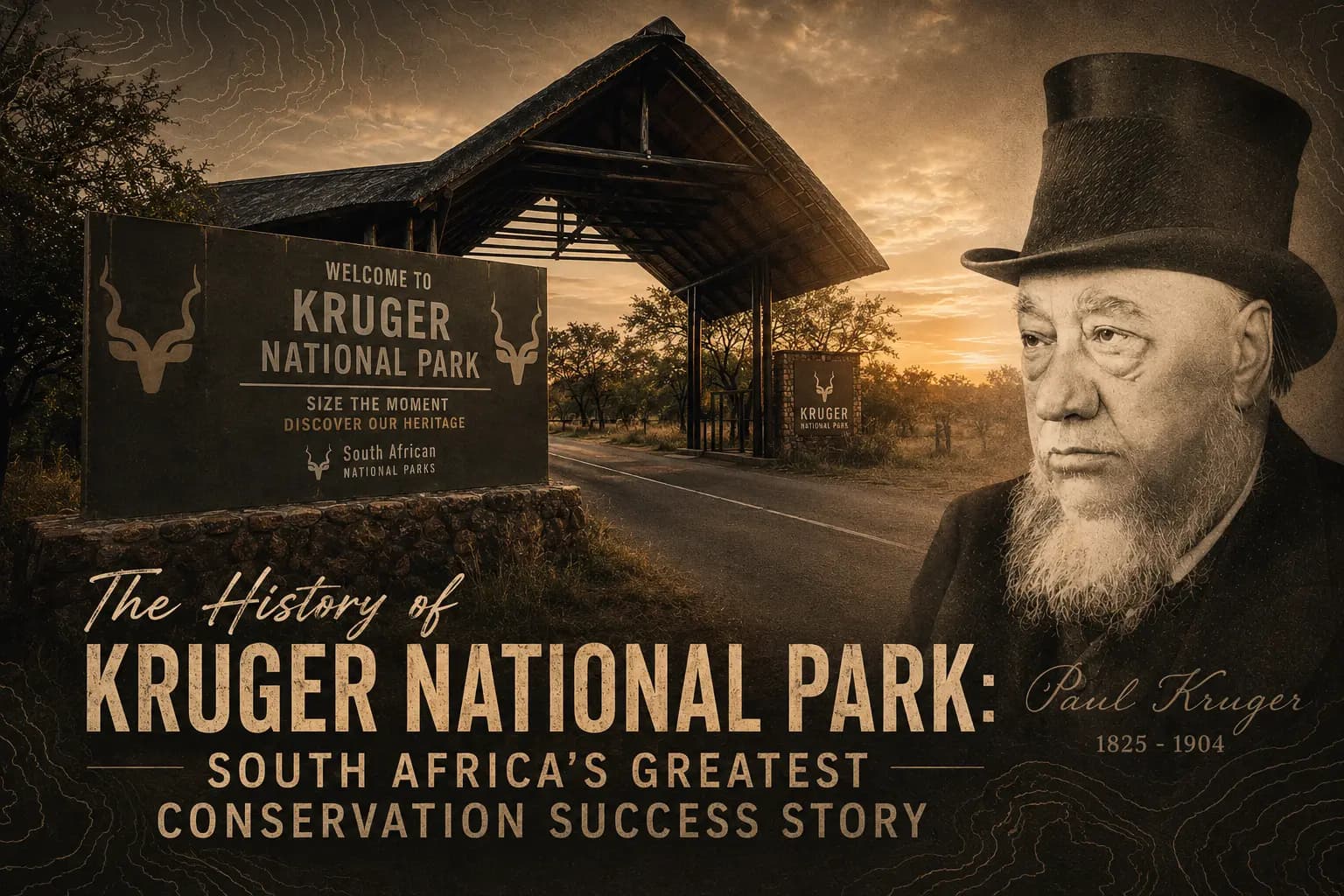
One of the most influential figures in Kruger's history was Paul Kruger, then President of the South African Republic. Although himself a hunter who understood the traditions of frontier life, Kruger recognised that wildlife populations could not withstand unlimited exploitation. He advocated for the establishment of protected areas where animals could recover without constant hunting pressure. His vision was remarkably progressive for its time and laid the foundation for modern conservation in South Africa.
In 1898, largely through Kruger's support, the government proclaimed the Sabie Game Reserve. Covering approximately 4,600 square kilometres between the Sabie and Crocodile Rivers, this reserve became the first official attempt to protect wildlife in the region. Hunting within its boundaries was largely prohibited, offering many species their first real opportunity to recover.
The creation of the Sabie Game Reserve marked a turning point in South African conservation history, but simply drawing boundaries on a map did not immediately solve the challenges facing the reserve. Wildlife protection required dedicated management, law enforcement, and individuals willing to safeguard the animals from poachers and illegal hunters.
Perhaps no individual played a greater role in transforming the reserve into today's Kruger National Park than James Stevenson-Hamilton. Appointed as the first warden of the Sabie Game Reserve in 1902, Stevenson-Hamilton devoted more than four decades of his life to protecting the area's wildlife. At the time of his appointment, the reserve faced enormous challenges. Poaching remained widespread, predators were often persecuted, and many people questioned the value of protecting animals instead of allowing unrestricted hunting.
Stevenson-Hamilton believed passionately that wildlife should be preserved in its natural environment for future generations. He introduced systematic anti-poaching patrols, expanded scientific management practices, and worked tirelessly to educate both government officials and the public about the importance of conservation. His dedication earned him the nickname "Skukuza," a Shangaan word meaning "the man who sweeps clean," reflecting the dramatic changes he brought to the reserve. Today, Skukuza remains the largest and busiest rest camp in Kruger National Park, serving as a lasting tribute to his legacy.
As conservation efforts gained momentum, the protected area gradually expanded. In 1903, the neighbouring Shingwedzi Game Reserve was established to protect additional wilderness to the north. Eventually, these two reserves would be merged into a single, much larger conservation area capable of supporting healthy wildlife populations across diverse ecosystems.
The official birth of Kruger National Park came on 31 May 1926 with the passing of the National Parks Act by the South African government. This landmark legislation formally united the Sabie and Shingwedzi Game Reserves under a single protected area, which was named Kruger National Park in honour of Paul Kruger's early conservation vision. It became South Africa's first national park and represented one of the continent's most ambitious conservation initiatives.
Initially, tourism within the park was modest. Roads were little more than rough tracks, accommodation was basic, and visitors often travelled by train before entering the reserve. Nevertheless, public interest steadily grew as more people became fascinated by the opportunity to observe Africa's iconic wildlife in its natural habitat. During the 1920s and 1930s, simple rest camps were established, gradually making the park more accessible to ordinary South Africans.
The decades that followed saw significant investment in roads, infrastructure, scientific research, and visitor facilities. New camps, picnic sites, bridges, and lookout points allowed visitors to explore increasingly remote areas while minimising their impact on the surrounding environment. Wildlife populations responded positively to continued protection, with elephants, lions, leopards, buffalo, and many antelope species gradually recovering from the severe declines experienced during the nineteenth century.
Kruger also became an important centre for scientific research. Biologists, ecologists, veterinarians, and conservation specialists used the park as a living laboratory to better understand complex ecosystems, predator-prey relationships, disease management, fire ecology, and habitat restoration. Much of the knowledge gained within Kruger has influenced wildlife management practices throughout Africa and beyond.
The latter half of the twentieth century also brought significant challenges. Human population growth around the park increased pressure on natural resources, while diseases such as bovine tuberculosis required careful monitoring. Water management practices evolved as scientists recognised that artificial interventions sometimes disrupted natural ecological processes. Conservation philosophy shifted away from attempting to control every aspect of nature toward allowing ecosystems to function more naturally whenever possible.
Following South Africa's democratic transition in 1994, Kruger National Park entered a new era. Greater emphasis was placed on working collaboratively with neighbouring communities, recognising historical injustices, promoting environmental education, and ensuring that conservation also delivered economic benefits through tourism and employment. Community partnerships became increasingly important in fostering long-term support for wildlife protection.
One of the park's most significant modern developments has been the creation of the Great Limpopo Transfrontier Park. Established through cooperation between South Africa, Mozambique, and Zimbabwe, this vast conservation landscape allows wildlife to move more freely across international borders, restoring ancient migration routes that existed long before political boundaries were drawn. This initiative reflects a growing understanding that successful conservation often requires regional cooperation rather than isolated protected areas.
Today, Kruger National Park protects an extraordinary diversity of life. More than 147 mammal species, over 500 bird species, around 114 reptile species, 34 amphibian species, dozens of fish species, and thousands of plant species thrive within its boundaries. Visitors travel from every corner of the globe hoping to witness the famous Big Five, but many soon discover that Kruger's true magic lies in its remarkable ecological richness. Every sunrise reveals new stories unfolding across rivers, grasslands, forests, and rocky hills, where predators stalk prey, elephants shape the landscape, and countless smaller creatures contribute to one of Africa's most intricate ecosystems.
Despite its global success, Kruger continues to face serious conservation challenges. Rhino poaching remains a persistent threat driven by illegal wildlife trafficking, while climate change is influencing rainfall patterns, water availability, and habitat dynamics. Invasive species, disease outbreaks, and increasing human development along the park's borders require constant vigilance from scientists and conservation managers. Fortunately, modern technology, international cooperation, and dedicated ranger teams continue to strengthen efforts to protect this priceless natural heritage.
Kruger National Park represents far more than a popular safari destination. It stands as one of the world's greatest examples of long-term conservation success, demonstrating what can be achieved when governments, scientists, rangers, local communities, and visitors share a commitment to protecting nature. From its origins as ancient human homeland to its transformation into South Africa's first national park, Kruger's story reflects both the mistakes and achievements of humanity's relationship with the natural world.
Every elephant crossing the road, every lion resting beneath an acacia tree, and every fish eagle calling across a river serves as a reminder of the foresight shown by those who believed this wilderness deserved protection. More than a century after the first game reserve was proclaimed, Kruger National Park continues to inspire wonder, educate millions of visitors, and preserve one of Africa's greatest natural treasures for generations yet to come. Whether you visit for the thrill of spotting the Big Five or simply to experience the timeless beauty of the South African bush, you become part of a story that has been unfolding for centuries-a story of resilience, conservation, and the enduring spirit of the wild.
New drops and field notes.
Built in South Africa · ESTD 2025