Journal
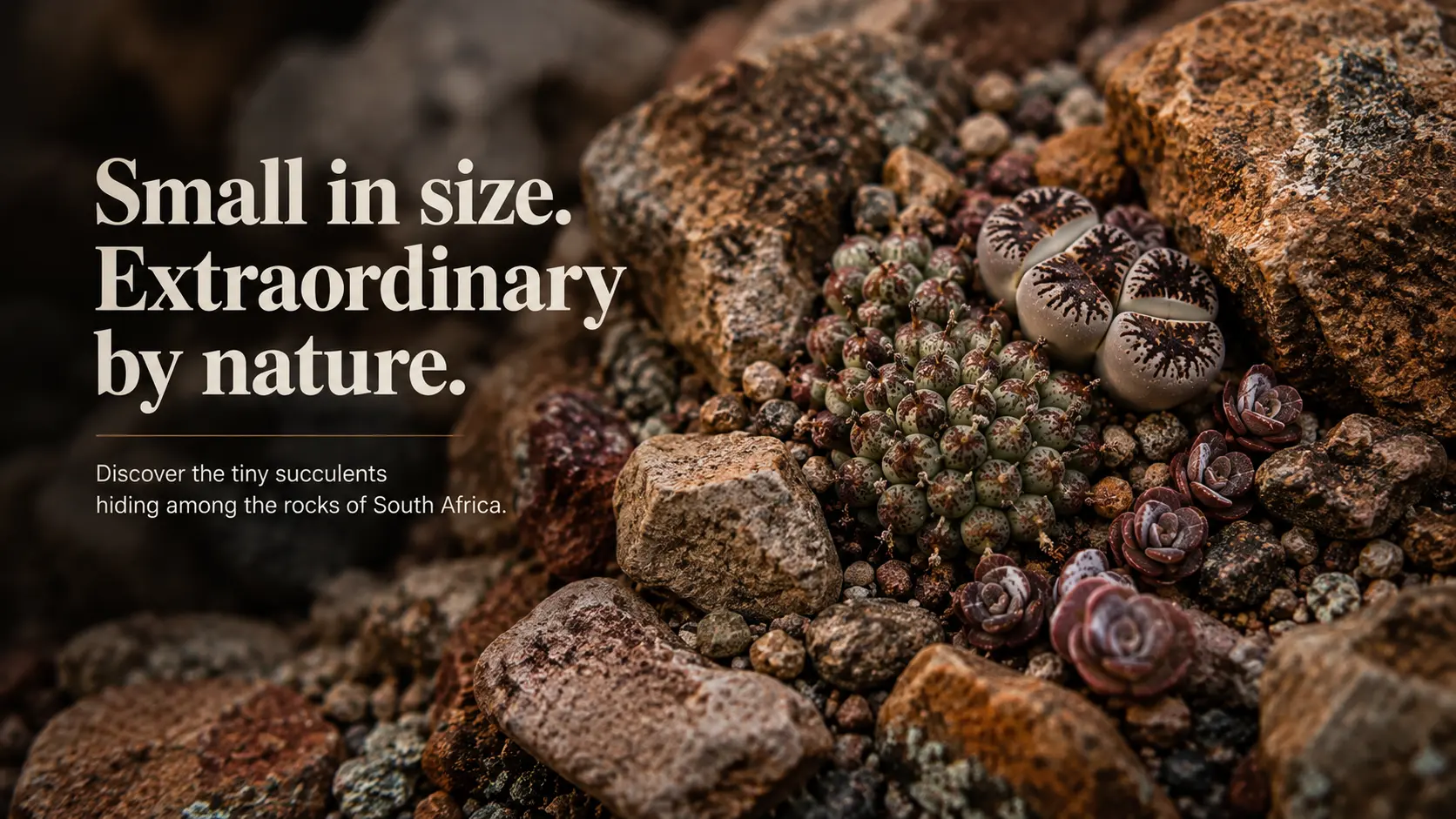
Discover the tiny succulents hiding among the rocks of South Africa.
South Africa is famous for its enormous diversity of succulents, from towering aloes and impressive euphorbias to the strange and beautiful living stones of the Karoo. Yet some of the country's most remarkable succulents are not the plants that immediately catch your eye. In fact, some are so small that you could easily mistake them for pebbles, pieces of gravel or tiny patches of moss. Hidden among the rocks of the Northern and Western Cape are some of the smallest succulent plants on Earth. Many belong to the genus Conophytum, a remarkable group of dwarf succulents in the ice-plant family, Aizoaceae. These miniature plants have evolved an extraordinary way of surviving in some of southern Africa's harshest landscapes, where rainfall can be scarce, temperatures can be extreme, and exposed vegetation must make the most of every drop of moisture. The world of these miniature succulents is a reminder that size has very little to do with resilience. What appears to be nothing more than a tiny green body pressed against a rock may actually be a highly specialised plant that has evolved over thousands of years to survive conditions that would challenge much larger vegetation.
A World Measured in Millimetres: When people think of succulents, they often imagine thick leaves, large rosettes, or plants that can eventually fill an entire pot. Conophytum challenges that idea completely. Some species are only a few millimetres across, while others may reach around a centimetre or a few centimetres in height. Conophytum minutum, for example, is described by the Stellenbosch University Botanical Garden as having a body only about 1 cm tall, making it one of the smallest dwarf succulents. It occurs naturally in parts of the Northern and Western Cape, particularly in areas such as Namaqualand and the Knersvlakte. Even more remarkable are members of Conophytum that are described as being among the smallest in their genus. SANBI's Red List assessment of Conophytum devium notes that the plants are extremely small and cryptic, with a semi-subterranean habit that allows them to remain largely hidden within their environment. There is therefore no single species that can simply be declared "the smallest succulent in South Africa" without qualification. Different species have different shapes, growth habits and measurements, and their size can vary depending on whether we are measuring height, width, individual bodies or an entire cluster. What can be said with confidence is that South Africa is home to an extraordinary collection of succulents whose entire visible bodies can be measured in millimetres.
The Incredible Conophytum: The genus Conophytum is perhaps the best example of just how far a plant can be reduced in size while retaining everything it needs to survive. SANBI describes Conophytum truncatum as one of the most highly reduced plants in existence. Rather than having obvious stems and numerous leaves, the plant essentially consists of a single pair of fused succulent leaves. These leaves are absorbed and replaced as part of the plant's annual growth cycle. The root system is extremely rudimentary, and there is barely any stem at all. Looking at one of these plants, it can be difficult to understand where one part of the plant ends and another begins. The body is essentially a specialised water-storage structure, allowing the plant to hold precious moisture inside its tissues. This unusual structure is one of the secrets behind its survival. Instead of spreading large leaves across the landscape and exposing itself to the sun, the plant keeps its body compact and close to the ground. Some species even grow partially beneath the surface, leaving only a small portion of the plant exposed. To a casual observer, this can make the plant almost invisible.
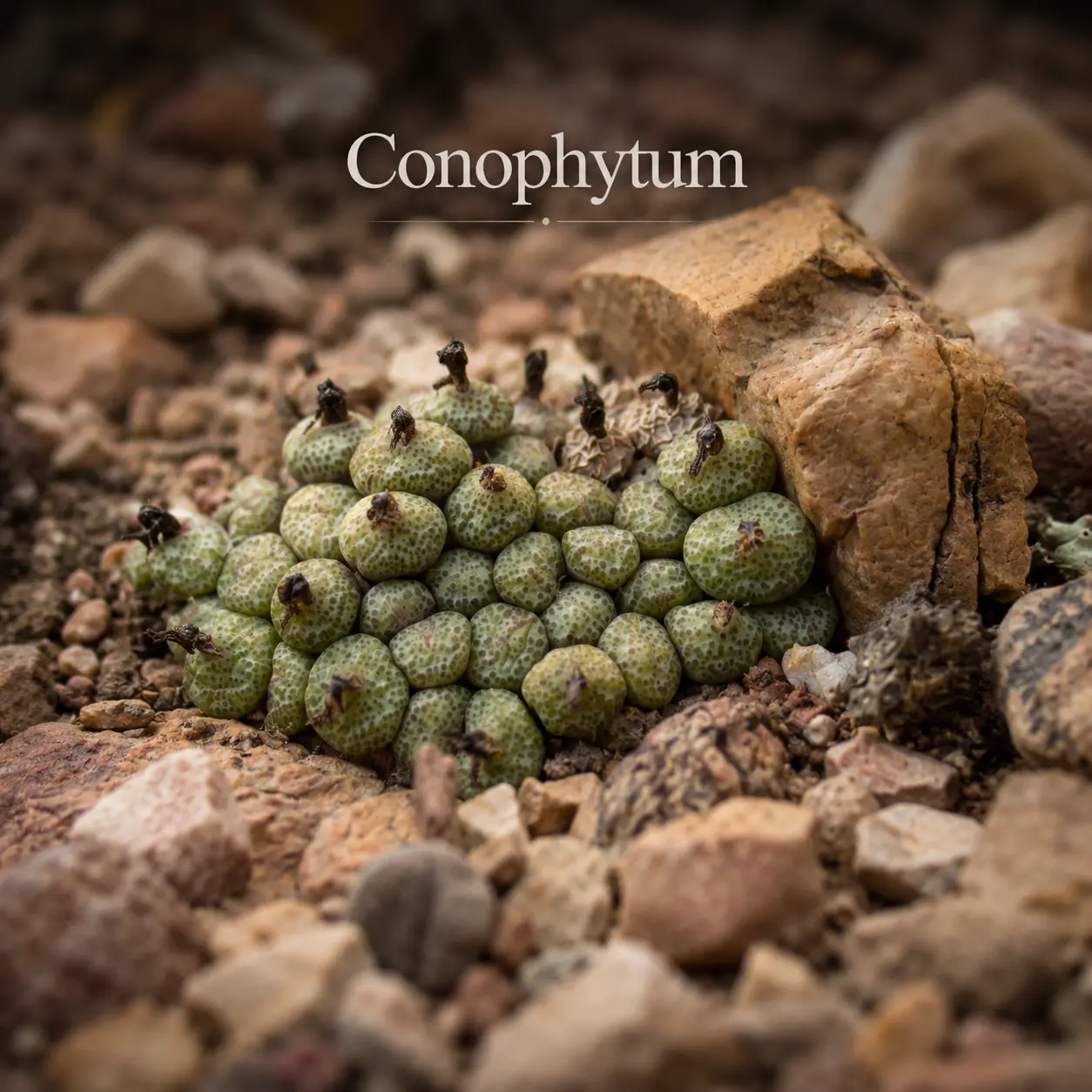
Masters of Disguise: One of the most fascinating characteristics of South Africa's smallest succulents is their ability to disappear into their surroundings. The dry landscapes of the Succulent Karoo contain countless rocks, stones, lichens, and patches of bare ground. A tiny Conophytum growing among them can be almost impossible to spot unless you know exactly what you are looking for. This camouflage is not accidental. Being small and inconspicuous can offer a significant survival advantage in an environment where intense sunlight, heat, drought and herbivory all pose challenges. Some species have colours and markings that closely resemble the rocks around them. Others retreat into crevices or grow in places where larger plants would struggle to establish themselves. Conophytum obcordellum, for example, can form small mats or mounds only around 20 to 30 millimetres high. Its highly ornamented bodies can display intricate markings, making each tiny plant look almost like a miniature piece of living artwork. The result is a plant that does not dominate its surroundings. Instead, it becomes part of them.
The Succulent Karoo: A Kingdom of Tiny Plants. The reason South Africa has such an incredible collection of miniature succulents is closely connected to its geography. The Succulent Karoo stretches across parts of South Africa and Namibia and is one of the world's great centres of succulent diversity. The region experiences a climate that has driven plants to develop highly specialised methods of surviving dry conditions. Research into Conophytum distribution found that the genus is primarily concentrated in the arid winter-rainfall regions of the Northern and Western Cape and southwestern Namibia. An extraordinary 94% of Conophytum taxa examined in the study were found only in the Succulent Karoo biome, while 88% occurred within South Africa. This makes the tiny Conophytum plants far more than botanical curiosities. They are part of one of the world's most important centres of plant diversity. Their small size is not a weakness. It is the result of millions of years of adaptation to a landscape where survival depends on efficiency.
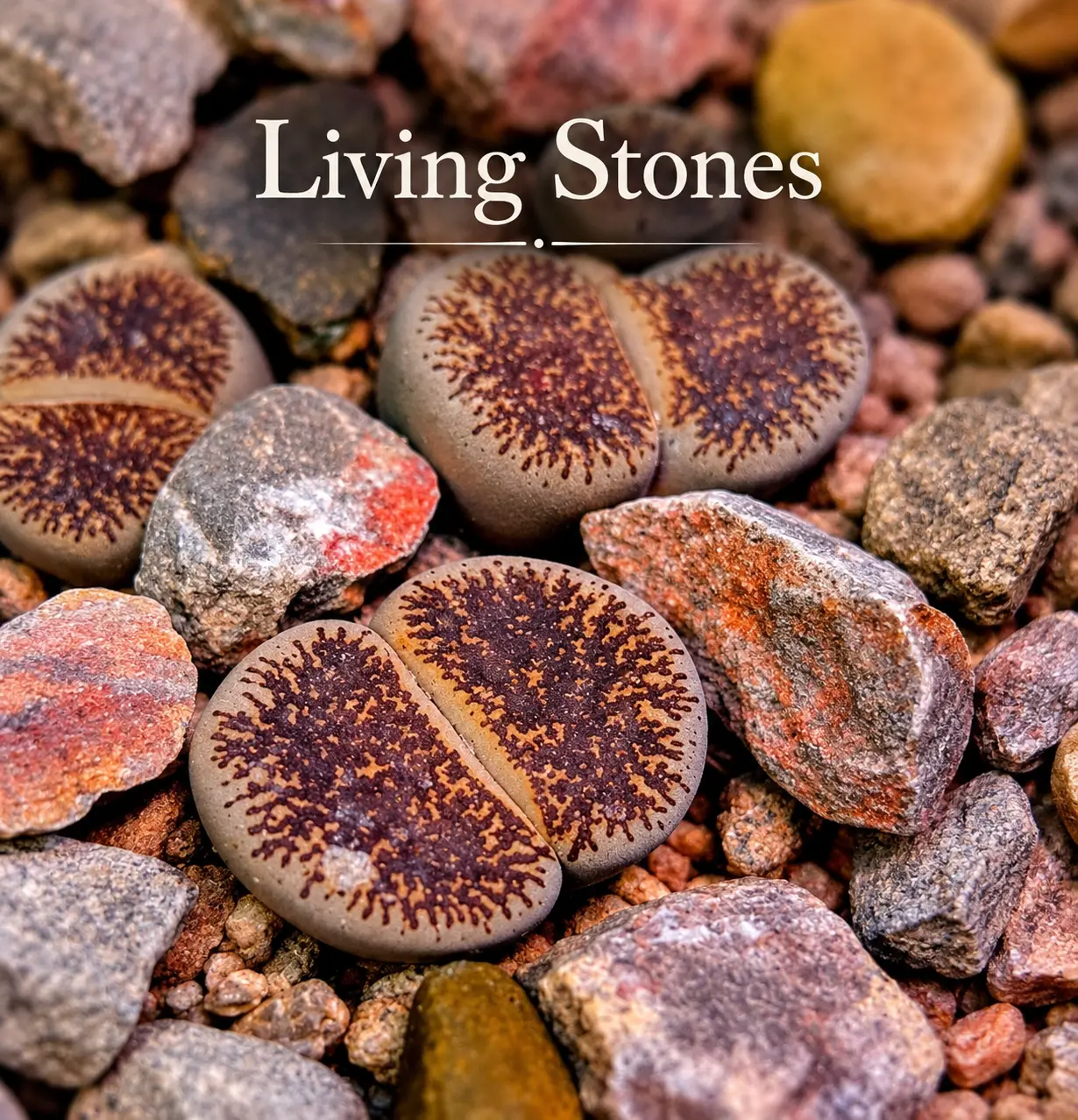
Living Stones, Dumplings and Little Green Gems: The appearance of these plants has inspired some wonderfully descriptive common names. Species of Conophytum are known by names such as dumplings, button plants, knopies, little toes, and water blisters. SANBI records several of these names for different species. The names make sense when you see them. Some look like tiny green or grey buttons sitting on the ground. Others resemble miniature stones. Some have a distinct central fissure that gives the plant the appearance of a tiny pair of joined leaves. Others form rounded clusters that look almost like small piles of pebbles. Their strange appearance is one reason they have become so popular with succulent enthusiasts around the world. But their beauty goes far beyond their unusual shapes. Under the right conditions, these miniature plants can produce surprisingly large and colourful flowers relative to their body size. Conophytum wettsteinii, for instance, produces attractive pink flowers in autumn. It is one of nature's great contrasts: a plant that may barely reach a centimetre in size producing a flower that seems enormous in comparison.
How Do Such Tiny Plants Survive? The secret lies in their ability to use their environment efficiently. Succulents survive by storing water within specialised tissues. In the case of Conophytum, the leaves have become highly modified and fused together, creating a compact structure capable of storing moisture. Their growth cycle is also adapted to the climate around them. Rather than continuously growing throughout the year, many species have periods of active growth and dormancy. During unfavourable conditions, the plant can reduce its activity and protect its living tissues. When suitable moisture and temperatures return, it can begin growing again. This strategy is particularly valuable in the Succulent Karoo, where rainfall can be highly seasonal and unpredictable. The plant's small size also means that it requires relatively little water to maintain itself. Instead of investing resources into large stems, branches, and leaves, it keeps its living structure incredibly compact. It is a perfect example of evolution producing efficiency rather than size.
More Than Just Conophytum: Although Conophytum is one of the most spectacular examples of miniature succulents in South Africa, it is not alone. South Africa's dry regions contain numerous dwarf members of the Aizoaceae and other succulent families. Plants such as Lithops, commonly known as living stones, have also developed highly specialised forms that allow them to survive close to the ground. The similarity between some of these plants is fascinating. Instead of looking like conventional vegetation, they can resemble stones or fragments of the landscape. This is especially effective in regions where bare ground dominates and vegetation is scattered. The strategy is simple but remarkably effective: stay small, store water, reduce exposure, and blend into the surroundings.
A Plant That Can Be Smaller Than Your Fingernail: Perhaps the most astonishing thing about these succulents is how easy it is to overlook them. Imagine walking through the Northern Cape. You see mountains in the distance, rocky slopes beneath your feet, and seemingly endless dry vegetation stretching across the landscape. You might walk straight past one of South Africa's most extraordinary plants without ever noticing it. A tiny Conophytum may be sitting in a crack between rocks, barely rising above the surrounding ground. From a distance, it may look like nothing more than a pebble. Only when you stop and look closely does its true nature become apparent. The plant's body, its markings, and its tiny fissure reveal that what looked like a stone is actually a living organism perfectly adapted to its environment. This is one of the great lessons of the South African wilderness. Some of the most fascinating things are not necessarily the largest or most obvious. Sometimes you have to slow down and look at the ground beneath your feet.
Tiny Plants Facing a Huge Threat: Unfortunately, the very characteristics that make these plants fascinating have also made some of them extremely vulnerable. Rare Conophytum species have become highly desirable among collectors, and illegal collection from the wild has become a serious conservation problem. SANBI assessments show that several species are experiencing significant declines as a result of illegal harvesting for the ornamental succulent trade. Conophytum comptonii, for example, is classified as Critically Endangered, with substantial recent losses attributed to illegal collection. The situation is even more difficult for some extremely restricted species. Conophytum chrisocruxum, which is endemic to the Northern Cape, is known from a single locality and has experienced the illegal removal of an estimated 80 to 90% of its mature individuals since 2019. It is classified as Critically Endangered. Another species, Conophytum confusum, has fewer than 100 mature individuals thought to remain in its only known locality according to SANBI's assessment. These numbers demonstrate just how fragile miniature succulent populations can be. When a plant exists naturally in only a small geographic area, removing even a relatively small number of individuals can have serious consequences. Unlike common garden plants, many of these species cannot simply be replaced by plants from another population because their natural distributions can be incredibly restricted.
Why You Should Never Collect Them From the Wild: The best way to appreciate South Africa's miniature succulents is to leave wild populations exactly where they are. A plant that may appear plentiful in one location could represent a genetically important population found nowhere else on Earth. Removing plants from the wild can damage not only individual specimens but also the ecological integrity of the habitat in which they evolved. Fortunately, responsible succulent enthusiasts can enjoy these remarkable plants through legally propagated specimens and cultivated plants from reputable sources. The distinction is important. Admiring a tiny Conophytum growing naturally between the rocks is an opportunity to witness evolution in action. Taking that plant home can contribute to the very pressures threatening wild populations. In the case of South Africa's rarest succulents, leaving them where they belong is one of the simplest and most meaningful forms of conservation.
Small in Size, Extraordinary in Survival: South Africa's smallest succulents are proof that nature does not need size to create something extraordinary. A plant only a few millimetres wide can contain an incredible evolutionary story. It can store water, survive drought, disappear beneath the soil, camouflage itself among rocks and wait for the right conditions to grow again. The Conophytum species of the Succulent Karoo are particularly remarkable because they have taken this strategy to an extreme. Their bodies have been reduced to tiny, highly specialised structures that allow them to survive where larger plants would struggle. Their existence also highlights just how much biodiversity can be hidden in seemingly barren landscapes. The next time you travel through the Northern Cape or Western Cape and see a rocky landscape that appears almost lifeless, take a moment to look closer. Between the stones and beneath the harsh African sun may be a miniature world of plants that have survived for generations through an extraordinary combination of patience, adaptation, and resilience. Some of South Africa's greatest botanical treasures are not towering above the landscape. Some are hiding beneath your feet. And sometimes, the smallest plants tell the biggest stories.
New drops and field notes.
Built in South Africa · ESTD 2025