Journal
The Strange Tale of South Africa's Railway Signalman
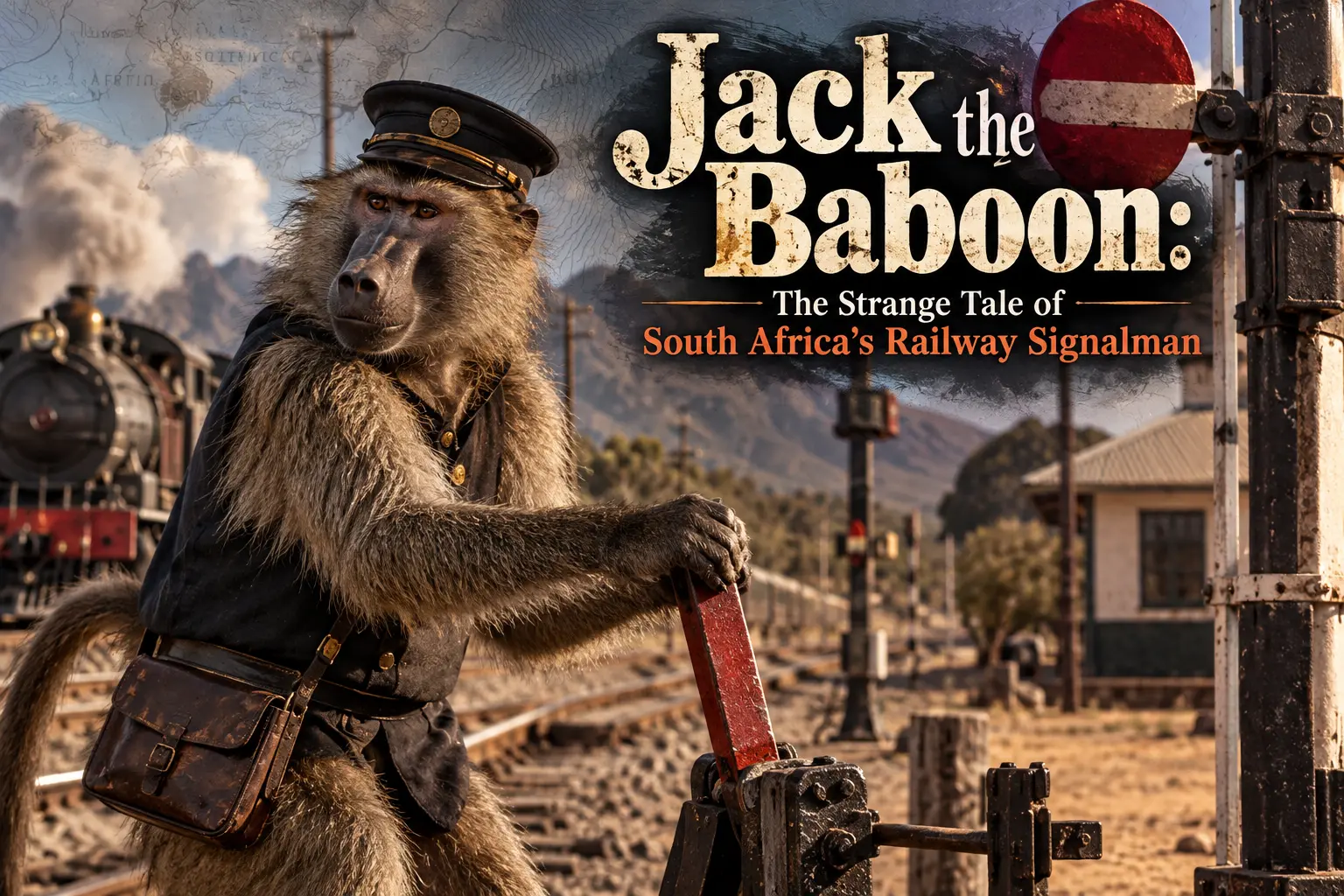
South Africa's history is filled with extraordinary characters. Hunters, explorers, pioneers, railwaymen and adventurers all played their part in shaping a country defined by vast distances, rugged landscapes and an often unforgiving wilderness. But among the many stories to emerge from nineteenth-century South Africa, few are as unusual as that of Jack. Jack was not a famous hunter or explorer. He did not lead an expedition into the African interior or discover an unknown mountain pass. He was a chacma baboon. And for approximately nine years, Jack worked alongside a railway signalman at Uitenhage in the Eastern Cape, helping operate railway equipment and becoming one of the most unusual employees in South African railway history. His story is a remarkable combination of human determination, animal intelligence and the changing face of South Africa during the age of the railway.
A Railwayman Called "Jumper" Wide: To understand Jack's story, we first need to understand the man who brought him into the railway world. James Wide was a railway worker in the Eastern Cape during the late nineteenth century. He became known as "Jumper" Wide because of his habit of jumping between moving railway carriages. It was a dangerous practice, and eventually it caught up with him. In 1877, near Kleinpoort in the Eastern Cape, Wide attempted one of these jumps. He fell beneath a moving railway carriage and suffered devastating injuries, losing both of his legs below the knees. For most people, such an accident would have ended their working life. Wide refused to let it. He constructed wooden prosthetic legs and eventually returned to employment with the railway. He worked as a signalman at Uitenhage railway station, where he was responsible for operating the mechanical signalling equipment used to control trains. But working around a railway station with two wooden legs was difficult. Wide needed assistance. That assistance would come from an extraordinarily unlikely source.
Enter Jack: The story goes that Wide encountered a chacma baboon being used to help lead an ox wagon. The animal immediately caught his attention. Wide acquired the baboon and named him Jack. At first, Jack's duties had nothing to do with railway signalling. He helped Wide with everyday tasks and assisted him as he moved around. One particularly important task was helping to push Wide's railway trolley. For Wide, the baboon was more than a curiosity. Jack became a practical companion who could help compensate for the physical limitations caused by his accident. But Wide soon discovered that Jack possessed an ability that would take their partnership in an entirely unexpected direction. Jack could learn. And he could learn remarkably complex routines.
From Railway Trolley to Signal Box: The railway of nineteenth-century South Africa was a very different world from the one we know today. There were no computerised signalling systems or sophisticated electronic control rooms. Railway workers relied heavily on mechanical equipment, hand signals, whistles and a system of levers and points. At Uitenhage, Wide worked with this equipment every day. Jack watched. According to historical accounts, the baboon gradually learned to respond to the railway routines surrounding him. He began by assisting with simple tasks. Over time, he learned the relationship between locomotive whistles and particular actions. Eventually, Wide began teaching Jack how to operate the railway signal levers. What may have started as observation became training. Jack learned that certain sounds meant certain actions. A locomotive approaching the station could give a particular whistle, and Jack learned to associate that sound with the appropriate railway operation. The animal was not simply wandering around a signal box pulling levers at random. He was learning a sequence of sounds, signals and physical actions. For a nineteenth-century railwayman, that was extraordinary.
The Chacma Baboon: Jack was a chacma baboon, a species native to southern Africa. Chacma baboons are highly social and intelligent primates, living in complex troops where individuals constantly interact, communicate, and learn from one another. In the wild, survival requires considerable awareness of their surroundings. Jack's story offers a fascinating example of how those natural abilities could be directed into an entirely human environment. He observed Wide. He learned from repetition. He associated sounds with actions. And eventually, he became capable of carrying out tasks that had previously been performed by a human railway employee. The railway signal box became Jack's classroom. The levers became his tools. And the passing locomotives became part of his daily routine.
When the Railway Authorities Found Out: Eventually, Jack's unusual occupation attracted attention. The idea of a baboon operating railway equipment was hardly something railway officials could simply ignore. According to accounts of the story, a passenger complained after seeing Jack working the railway signals. The authorities investigated, and Wide was reportedly dismissed. But Wide was given an opportunity to demonstrate what Jack could actually do. The railway officials watched. The locomotives approached. Whistles sounded. And Jack reportedly responded by operating the appropriate railway equipment. The demonstration was apparently convincing enough for the authorities to allow Wide to return to his position, with Jack continuing to assist him. This is one of the most remarkable elements of Jack's story. It was no longer simply an unusual arrangement between a disabled railwayman and his animal companion. The railway authorities had apparently tested the animal and accepted that Jack could perform useful railway duties.
Jack the Signalman: Jack's story became famous. Accounts state that he was eventually recognised as an official railway employee or assistant and received payment for his work. Some later accounts state that he earned twenty cents a day and received a weekly allowance of beer, although details surrounding his remuneration vary between historical retellings. What is consistently reported is that Jack remained alongside Wide for approximately nine years. During that time, he became known as Jack the Signalman. Imagine the scene. A steam locomotive approaches through the Eastern Cape landscape. Smoke rises above the railway line. The great iron machine whistles as it approaches the station. Inside the signal box sits a railwayman who lost both his legs in a railway accident. And beside him is his unusual assistant - a chacma baboon who has learned the railway system. It sounds like something from a South African folktale. Yet Jack's story has endured through historical accounts and contemporary interest.
More Than a Railway Worker: Jack's abilities apparently extended beyond the railway. He was reported to assist Wide around his home, performing simple household tasks and helping with physical work. He also reportedly acted as a guard, becoming protective of Wide and reacting to unfamiliar people. The relationship between the two appears to have been built on trust and repetition. Wide depended on Jack. Jack depended on Wide. Together, they formed a partnership that would have been almost impossible to imagine elsewhere. It was a partnership born out of adversity.
A Life Beside the Tracks: South Africa's railway expansion during the nineteenth century transformed the country. Railways connected inland communities with ports, allowed goods and livestock to travel greater distances, and opened new routes across the landscape. They also created dangerous working environments. Steam locomotives, heavy machinery, moving carriages and mechanical signalling systems demanded discipline and constant attention from railway workers. For Jack, the railway became his workplace. He spent years surrounded by the sights and sounds of steam-powered South Africa. The whistle of locomotives. The clatter of wheels against steel. The movement of railway workers. The mechanical operation of signals. And somewhere within that world was a baboon that had learned how it all worked.
The End of Jack's Story: Jack's remarkable railway career eventually came to an end in 1890. He died after contracting tuberculosis. By then, he had reportedly spent around nine years working alongside Wide. For a chacma baboon, it was an extraordinary life. Jack had gone from assisting with an ox wagon to becoming part of a railway operation. His story had taken him from the dusty roads of the Eastern Cape to the mechanical world of steam locomotives and railway signals. But perhaps the most remarkable part of the story was never the railway itself. It was the partnership.
A Story of Determination: There is something distinctly South African about the story of Jack and James Wide. It is a story born from difficult circumstances. Wide suffered an accident that could easily have ended his career. Instead, he adapted. He built his own prosthetic legs and returned to work. Then he found an unlikely companion. Jack, in turn, adapted to Wide's world. The two learned to work together. One was a railwayman who had lost both his legs. The other was a wild African primate that learned to operate railway equipment. Their story reminds us that the history of the South African outdoors is not only found in great expeditions, famous hunters, or remote wilderness areas. Sometimes it can be found beside an old railway line. Sometimes it is hidden in the story of an ordinary working man. And sometimes, it has four legs, a long tail, and an extraordinary ability to learn.
Jack's Legacy: Today, the story of Jack the baboon remains one of the strangest chapters in South African railway history. His remains have been associated with the Albany Museum in the Eastern Cape, giving this unusual story a tangible connection to the present day. Whether every detail repeated in modern retellings can be independently verified is difficult to establish, particularly when it comes to the exact details of Jack's salary and some of the more colourful stories surrounding his work. But the central story has endured: a railwayman named James "Jumper" Wide, after losing both legs, trained a chacma baboon to assist him, and Jack became closely associated with railway work at Uitenhage. More than a century later, Jack remains a fascinating reminder of a very different South Africa. A country of steam locomotives and dirt roads. Of ox wagons and railway lines. Of vast distances and rugged landscapes. And of people who found extraordinary ways to overcome extraordinary circumstances.
The Baboon Who Went to Work: There are countless stories hidden within South Africa's history. Some are found in old hunting journals. Others are written into the landscape itself. Some survive in family stories passed from one generation to the next. And then there is Jack. A chacma baboon who went to work. For approximately nine years, he stood beside the railway tracks of the Eastern Cape, helping the man who had refused to let a terrible accident end his working life. Jack was not an explorer. He was not a soldier. He was not a famous pioneer. He was a railwayman. And perhaps that is what makes his story so fascinating. Because among the thousands of people and animals that have passed through South Africa's history, few can claim to have had a job quite like Jack's.
New drops and field notes.
Built in South Africa · ESTD 2025